How to Choose an Asian Sauce Supplier for Importers and Distributors
How to Choose an Asian Sauce Supplier for Importers and Distributors
Share
publisher
Yinghok Food & Beverage Wholesale Manufacturer
Issue Time
Aug 26,2026
Summary
A practical, evidence-aware guide for food importers, regional distributors and wholesalers on selecting the right Asian sauce supplier: designing a market-fit portfolio, evaluating manufacturer capability beyond the catalog, confirming quality and compliance documents, comparing packaging, MOQ and logistics, planning commercial terms, and setting up long-term distribution support — with ready-to-use sourcing brief, scorecard and checklists.
For food importers, regional distributors and wholesalers, selecting the right Asian sauce supplier is a commercial decision that affects product range, compliance risk, logistics cost and long-term growth. This guide walks you through practical, evidence-aware steps to design a market-fit Asian sauce portfolio, evaluate manufacturer capability beyond catalog claims, confirm necessary quality and export documents, compare packaging and logistics options, plan commercial terms and MOQs, and set up long-term distributor support.
Where useful this guide refers to verified capabilities described by suppliers — for example, Yinghok’s public information documents the company’s work in research, customization and production of Asian-style sauces and seasonings, plus OEM/ODM and wholesale solutions — but importers must validate product-level documentation and commercial terms with any supplier before contracting. For supplier contact and technical support see Yinghok’s contact page.
Why Partner with Yinghok — A Leading Asian Sauce Manufacturer
When evaluating the points in this guide, keep in mind the verified strengths that set Yinghok apart as an Asian sauce manufacturer and OEM/ODM partner for importers and distributors:
Established since 2001 — 20+ years of Asian sauce research, customization and production experience.
Three manufacturing bases, a 70,000+ m² factory area and a team of around 200 employees.
Five integrated processing bodies with 300,000+ tons of annual output and 60+ registered trademarks — capacity and consistency to scale from pilot to bulk supply.
Low MOQs, free samples and prompt delivery to help you validate products quickly and manage cash flow.
Full OEM/ODM and private-label support: customize recipes, packaging and multilingual labels for your brand.
Internationally food-safety certified and R&D-driven, with a documented sample → testing/feedback → quotation → production workflow.
H2 sections in this document cover portfolio building, supplier capability, compliance documents, packaging and logistics, MOQs and commercial planning, long-term support, practical tools and next steps. The document ends with a compact SEO brief, keyword mapping, image plan, three short FAQs and sources.
Build the Right Asian Sauce Portfolio
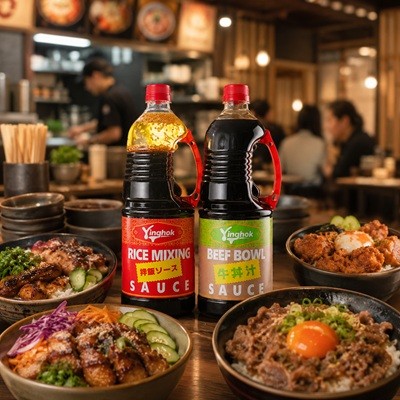
Build your portfolio around hero Asian sauce SKUs — from ramen tare to dipping sauces.
A distributor’s first commercial decision is which categories and SKUs will deliver margin and velocity in each channel. Portfolio design should be driven by channel (retail vs foodservice), customer use-cases (sushi, ramen, barbecue, stir-fry), local taste profiles, and SKU rationalization for inventory efficiency.
Key category buckets for consideration
Japanese sauces: soy sauce variants (all-purpose, tamari, low-sodium), sushi dipping sauces, mirin-style glazes, tare (ramen base) concentrates and sushi dressings.
Korean sauces: gochujang-based pastes and sauces (table sauces, braising sauces), BBQ marinades, ssamjang and kimchi adjunct sauces.
Chinese and pan-Asian cooking sauces: oyster-style, hoisin-style, black bean, sweet and sour, stir-fry concentrates, sesame sauces.
Regional specialty sauces: Thai sweet chili, Vietnamese dipping sauces (nuoc cham concentrates), Indonesian kecap manis-style sweet soy.
(Hold these as category examples — they are generic market categories and not claims about specific current SKUs. For a supplier’s published product list see their product index.)
Japanese sauces
Why include them: Japanese sauces often have strong brand recognition and repeat purchase cycles in retail; foodservice demand comes from sushi bars and izakaya formats.
Commercial considerations: multiple variants (regular, reduced sodium, tamari for gluten-sensitive customers), clear labeling for wheat/soy allergens, concentrated tare for foodservice vs ready-to-use retail bottles.
Korean sauces
Why include them: rapid global growth in Korean cuisine drives an expanding aisle presence and foodservice adoption.
Commercial considerations: heat level segmentation, gochujang as paste vs sauce, formulation consistency for cross-border taste parity.
Foodservice packs: high-fill drums, dispensers, bag-in-box, culinary concentrates with technical use instructions and dosing guidance.
Hero SKUs vs Complementary SKUs
Hero SKUs: a small number of high-velocity SKUs that define the brand and secure shelf/case space.
Complementary SKUs: flavors, heat variants, pack sizes and adjuncts (e.g., marinades or dipping sauce sachets) that increase basket size and cover use-cases.
Local market fit and SKU rationalization
Start with a core hero lineup for launch (often 6–12 SKUs across hero flavors and two channel pack types), then expand based on sell-through data.
SKU rationalization should balance assortment breadth with inventory turns and sales data; maintain an evergreen core and test seasonal/specialty SKUs via limited runs.
Practical note: check a supplier’s published categories and customization workflow when planning portfolio layout. Yinghok publishes a product index and a customization/workflow page describing sample development and production processes.
Suggested action: Request a category mapping and sample kit focused on your top 3 target channels (retail, quick-service restaurant, foodservice) to validate fit and pricing.
Evaluate Manufacturer Capability
A supplier’s catalogue is only the start. For importers and distributors you must evaluate the manufacturer’s technical, production and operational capabilities that underpin reliable supply and product consistency.
Capability checklist — what to verify beyond the catalog
R&D and customization: can the supplier reformulate for local taste, reduced-allergen, or private-label specifications? What is the sample and approval workflow?
Process and production controls: are there documented process controls (batch records, critical control points, sanitation programs)?
Batch consistency and scale-up: evidence of repeatability from lab sample to commercial batch; mechanisms for pilot to scale transition.
Packaging flexibility: capacity for retail and foodservice formats, private-label artwork options and multilingual label production.
Technical communication: dedicated technical contact, ability to provide detailed spec sheets, shelf-life studies and dosing instructions.
Sample development and approval: reproducible sample service, challenge testing and organoleptic panels as required.
Quality release and traceability: batch-level COA availability, lot traceability, recall traceability protocols and change control programs.
Change control: written procedures for material, formulation, process and packaging changes, plus notification timelines for customers.
Supply continuity and capacity planning: how are production slots allocated, and what contingency plans exist for raw material shortages?
Questions to ask a prospective supplier
Describe your R&D to commercial-scale workflow and customer sample process.
What is your procedure for handling formula or label change notifications and how are existing SKUs version-controlled?
How do you manage allergen segregation and cross-contact controls on shared lines?
Can you provide representative batch COAs and traceability documentation for sample lots?
How are complaints and CAPA handled, and can you provide anonymized examples of root cause investigations?
Red flags in capability assessment
Absence of a technical contact or refusal to share sample-level COAs.
Vague answers on batch traceability, change control or allergen segregation.
No documented process for shelf-life determination, especially for sauces with low pH or thermal processing requirements.
Practical reference: Yinghok’s customization page outlines the general workflow for sample development, testing/feedback, quotation and production; use those published steps to frame supplier process questions during supplier selection.
Yinghok advantage: as an in-house manufacturer with dedicated R&D, we run a documented sample-development, testing/feedback, quotation and production process — the practical framework the checklist above recommends you verify with any supplier.
Confirm Quality and Compliance Documents
Importers and distributors carry regulatory and commercial responsibilities for products they place in market. Confirm and retain the necessary product-level documentation before shipment.
Core document set to request for each SKU
Product specification (detailed version): formulation, ingredient declaration, allergens, declared net weight, storage conditions, and recommended handling.
Ingredient and allergen declarations: clear ingredient list and allergen statements, with cross-contact potential noted.
Nutrition information panel: per-country requirements differ; ask for raw calculation method or analytical results.
Certificate of Analysis (COA): representative analytical results for the batch(es) to be supplied (microbial, pH, Brix, salt, heavy metals if applicable).
Shelf-life basis: stability study summary and recommended shelf-life with storage instructions and accelerated study data if used.
Lot coding and traceability: description of lot coding system and traceability capability from finished goods back to raw materials.
Microbiological and chemical testing results: as relevant (e.g., total plate count, yeasts/molds, pathogens, preservatives).
Claims substantiation: documentation for any label claims (e.g., “low sodium”, “no MSG”, “gluten-free”) including methodology and thresholds.
Certificates where relevant: manufacturer’s certificates (e.g., HACCP, ISO food safety standards) if provided — but note that verification and acceptance reside with the buyer.
Packaging artwork files and label proofs: final multilingual label proofs, production run approval and lot-specific label traceability.
Export documentation
Commercial invoice and packing list: must accurately reflect commercial terms, HS codes, unit counts and gross/net weights for customs clearance.
Certificate of origin: used for preferential duty claims where applicable (importer must verify eligibility).
Phytosanitary or veterinary certificates: rarely needed for sauces, but required if ingredients subject to agricultural controls.
Health or sanitary certificates: country-to-country requirements vary; confirm with importer’s customs broker and regulatory authority.
Regulatory declarations and importer responsibilities: the importer is typically responsible for destination-market labeling compliance, registration or pre-market notifications where required.
Regulatory references: use destination-country government sources (e.g., FDA for U.S. imports) and international guidance (e.g., Codex General Principles of Food Hygiene) to identify mandatory paperwork.
Compliance governance tips
Always request batch-level COAs and retain them for import entry and traceability.
Validate label claims and allergen statements against destination-market requirements before printing and shipping.
Use a customs broker early in the process to confirm HS codes, duties, and quarantine or licensing requirements.
Practical note: public frameworks such as FDA guidance and Codex principles are useful context for food-safety expectations, but importers must verify country-specific rules with local regulatory authorities.
Yinghok advantage: our international food-safety certifications and in-house quality release support batch-level COAs, lot traceability and the product/export document package (specs, ingredient & allergen declarations, nutrition info, shelf-life basis, commercial invoice, packing list and certificate of origin).
Compare Packaging, MOQ and Logistics
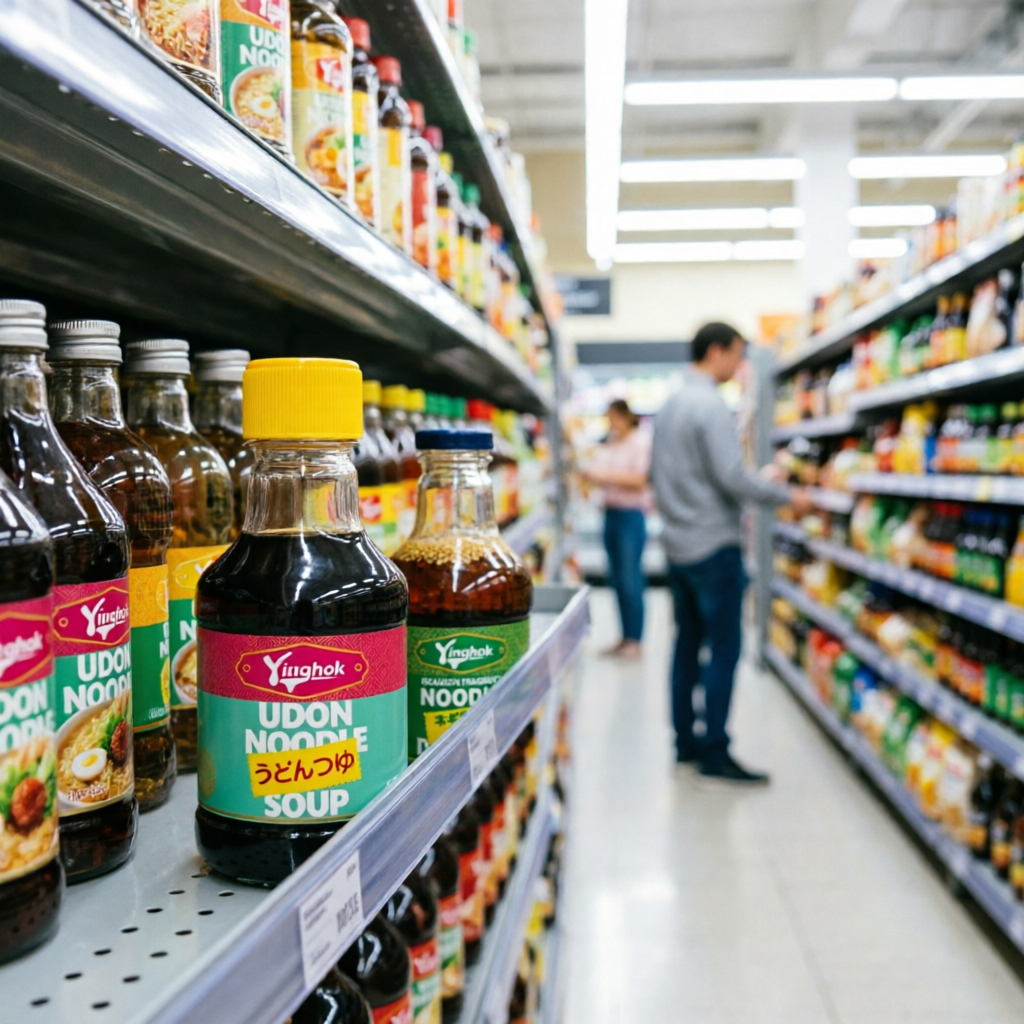
Match pack formats and MOQs to each channel, from retail bottles to foodservice bulk.
Packaging and logistics choices materially change landed cost, shelf life and in-market handling. Compare packaging formats and logistical implications as part of supplier selection and commercial negotiation.
Retail packs
Typical considerations: consumer-oriented bottles, glass or PET, tamper-evident closures, dispensing controls (nozzle caps), UPC and consumer barcode placement, cartonization for shelf-facing presentation.
Label content: nutrition panel, ingredients and allergen declarations, storage and usage instructions in required languages, traceability lot code location.
Artwork and production: lead times for label printing, label Minimum Order Quantities for printed sleeves or bespoke colors — verify supplier’s capacity for multilingual artwork runs.
Foodservice packs
Formats: bag-in-box, pails, drums, concentrated sachets, or bulk liquid totes. Foodservice packs prioritize ease of dosing, pump compatibility and refillability.
Technical support: dosing charts, dilution ratios and equipment compatibility notes are crucial for foodservice customers.
Shelf life: foodservice concentrates often have different stability profiles after opening — clearly document keep-open or in-use shelf-life.
Packaging logistics and transport considerations
Palletization and cube optimization: packaging shape and pallet configuration impact freight efficiency and cost.
Temperature and storage: identify ambient vs refrigerated requirements and ensure logistic partners can maintain required conditions.
Customs and handling: fragile items (glass bottles), heavy drums and non-standard pallet heights may trigger specialized handling fees.
Label multilingualism: shipping multi-language labeled product or overstickers; decide whether to print final destination-language labels at origin or apply labels upon arrival (each has customs and traceability impacts).
Document and transaction coordination
Commercial invoice, packing list and certificate of origin often accompany shipping documentation; coordinate with your customs broker early to avoid delays.
Incoterms: confirm Incoterm for first shipment and for ongoing orders (e.g., EXW, FOB, CIF) and ensure both parties agree on responsibilities for freight, insurance and customs.
Packaging sustainability and retail requirements
Retailers increasingly ask about recyclability, recycled content and packaging weight; use supplier-supplied packaging data sheets to evaluate environmental claims.
Practical reference: Yinghok’s foodservice page describes customized condiment solutions and packaging options for restaurant chains and stores; use such supplier-provided pages to assess pack-format flexibility.
Yinghok advantage: flexible MOQs, low-minimum private-label artwork runs and both retail and foodservice pack formats (bottles, sachets, bag-in-box, pails/drums) help you match pack economics to each channel.
MOQ and Commercial Planning
MOQ (minimum order quantity) and commercial planning are negotiation points that shape cashflow, inventory and service level. Because MOQs vary by ingredient, pack format, and production line constraints, plan commercially to balance risk and cost.
Commercial planning elements to define before contracting
Ingredient and packaging MOQs: confirm both raw material and label printing MOQs; custom labels often have separate minimums.
Mixed-SKU orders: ask about flexibility for mixed-SKU palletization and whether there is a penalty for low-mix, high-SKU small runs.
Forecasting and lead time alignment: provide a rolling forecast to the supplier and confirm how production slots are allocated against forecasts.
Safety stock and call-offs: negotiate safety stock levels at supplier or third-party warehouse; establish call-off terms or consignment options if feasible.
Production slots and changeover costs: understand how changeovers are charged and minimum production runs for bespoke formulations or packaging.
Reorder points and replenishment: define reorder point methodology (time-based vs sales-based) and expected lead times for reorders.
Financial terms: agree upfront on payment terms, currency, and documentary requirements (e.g., letter of credit vs TT) and who bears foreign exchange risk.
Landed cost modeling: include duties, inland freight, brokerage, insurance and contingency margin to compute true landed cost per SKU.
Negotiation tips
Use a phased approach: start with a manageable first order to validate product, packaging and logistics, then scale based on performance.
Seek mixed-MOQ concessions in exchange for longer-term contract commitments or higher aggregate volume.
Consider service-level agreements (SLA) for fill rates, lead-time adherence and quality release protocols.
Commercial governance
Implement regular commercial reviews (monthly/quarterly) with KPIs for fill rate, lead time variance, claim rate and cost variance to keep the supplier relationship aligned.
Request an Asian Sauce Portfolio Review to align MOQ impact with your assortment and financial model.
Plan Long-Term Distribution Support
Long-term success requires supplier support beyond delivery: technical training, marketing materials, recipe development, artwork updates, complaint handling and new product development.
Supplier support functions to require contractually or operationally
Sample kits and training: ask for distributor sample kits, product fact sheets and product training sessions (onsite or remote) for sales teams and foodservice chefs.
Application recipes and menu support: recipe cards and usage guides tailored to target channels (e.g., dilute ratios for ramen tare, glazing instructions for barbecue).
Market feedback and iteration: structured feedback loops for early launch markets to allow rapid reformulation or packaging updates based on consumer response.
Artwork production and updates: a clear process for label revisions, lead times for artwork approval, and responsibilities for translation accuracy.
Change notifications and version control: written advance notice timelines for formulation, packaging or ingredient changes.
Complaint handling and CAPA: documented complaint intake, root-cause analysis and Corrective and Preventive Action processes; escalation paths and response time expectations.
Business continuity and NPD roadmaps: ask about business continuity plans for supply interruptions and the supplier’s product development calendar for seasonal SKUs or new adjacencies.
Operationalizing support
Joint business plans (JBP): define sales targets, promotional support, co-op marketing, and training phases.
Distributor enablement: include digital assets (high-resolution photos, spec sheets, MSDS), pricing tier structures, and marketing collateral as part of onboarding.
Practical reference: Yinghok’s customization workflow and contact channels include sample development, testing and technical support; use supplier contact pages to request the full menu of distributor support services.
Yinghok advantage: beyond supply, we provide distributor sample kits, spec sheets, recipe & menu support, artwork updates and structured feedback loops to help you launch, train and grow in your target markets.
Ask for Samples and Export Documents to verify support capabilities and document completeness before the first order.
Supplier Selection Tools: Brief, Scorecard and Checklists
Below are practical tools you can adapt and send to shortlisted suppliers to accelerate evaluation and reduce selection risk: a sourcing brief template, a supplier evaluation scorecard, a document request checklist and a first-shipment readiness checklist.
Sourcing brief (use as a one-page briefing for suppliers)
Supplier evaluation scorecard (use a 100-point model — weight per your priorities)
Document request checklist (per SKU)
Product specification (final)
Ingredient list and allergen declaration
COA for proposed batch and typical batch COA
Nutrition information and calculation method
Shelf-life study summary and storage conditions
Microbiological test results for recent batches
Label proofs and artwork files (source)
Traceability description and lot coding sample
Packaging material datasheet
Statement of composition for any claims (e.g., “gluten-free”)
Final product specs and approved label proofs signed off
Final COA and lot numbering confirmed for shipment
Commercial invoice and packing list generated with HS codes
Certificate of origin availability confirmed (if required)
Shipping marks and carton labeling conform to buyer requirements
Container/pallet weight and cube confirmed for freight booking
Customs broker briefed and provisional clearance files submitted
Insurance and Incoterm responsibilities confirmed
Traceability file (batch records) stored and accessible
Arrival handling plan and warehouse receiving timeslot booked
Scorecard and checklists should be customized to your company’s risk tolerance and the specific regulatory environment of destination markets.
Next Steps, Negotiation Tips and CTAs
Operational steps to move from selection to first shipment
Shortlist 2–3 suppliers and issue the sourcing brief with a request for samples and full document package.
Evaluate responses using the supplier evaluation scorecard and conduct technical calls to clarify process and COA access.
Agree on a pilot order scope (mixed-SKU, limited volume) and final label proofs; define acceptance tests and release criteria.
Confirm the first-shipment readiness checklist and align on Incoterms and logistics partner.
Run commercial KPI cadence and supplier SLAs for ongoing performance.
Negotiation tips
Trade some MOQ flexibility for longer-term purchase commitments or forecast guarantees.
Request batch COAs during the sample and pilot runs — withhold final payment terms until satisfactory COAs and labeled samples are received.
Use staggered payments or letter of credit instruments to manage cashflow and supplier assurance.
CTAs (pick one when you are ready)
Request an Asian Sauce Portfolio Review — have a supplier or consultant map SKU fit to your channels and margin model.
Ask for Samples and Export Documents — obtain batch COAs, label proofs and tested samples for sensory and stability assessment.
Discuss Wholesale, Packaging and Replenishment — negotiate MOQs, pack formats and replenishment cadence with potential suppliers.
For supplier-specific inquiries, technical support or to request customized development services you can contact suppliers directly; for example, see Yinghok’s contact information and their published customization workflow and product index:
Ready to Work with a Customized Asian Sauce Expert?
Yinghok combines low MOQs, free samples, prompt delivery, full OEM/ODM & private-label services and a full line of Japanese, Korean and Chinese cooking sauces — from ramen tare and sushi sauces to gochujang, mirin, vinegar and sake. Visit Yinghok’s homepage, product index, customization workflow, foodservice solutions or contact page to request samples, export documents or an Asian Sauce Portfolio Review.