Japanese Seasonings for Food Manufacturing and Their Effects on Flavor and Processing
- Share
- publisher
- Yinghok Food & Beverage
- Issue Time
- Sep 12,2026
Summary
A practical B2B guide to Japanese seasonings in food manufacturing: how rice vinegar, sushi vinegar, Hon Mirin, Mirin Fu, cooking sake and grain vinegar affect flavor, texture and processing, plus formula customization, MOQ, certification and documentation checks, packaging and label coordination, and the route from sample development to bulk OEM supply.

Japanese seasonings are not only flavor ingredients. In a commercial food system they also influence batch consistency, sauce viscosity, browning, acidity, aroma, line efficiency, label requirements and finished-product positioning. That is why a food manufacturer, restaurant group or private-label buyer should evaluate a seasoning supplier by more than taste alone. The right supplier should be able to discuss the intended application, target flavor, ingredient and allergen requirements, packaging format, minimum order quantity (MOQ), documentation, sample approval, production controls and export coordination before a purchase order is issued. A seasoning that performs well in a kitchen trial may still need adjustment before it can run consistently through a central kitchen, retort process, filling line, frozen-food operation or retail supply chain. Yinghok is a Japanese seasoning manufacturer with more than 20 years of Japanese flavor development and food production experience. Its Custom Japanese Seasonings range covers Cooking Sake, Hon Mirin (sweet rice wine), Rice Vinegar and Grain Vinegar, with Mirin Fu offered as a cost-effective mirin alternative, plus sushi vinegar and sushi soy sauces for buyers who need a coordinated programme from one supplier. The exact formula, documentation, certification status, MOQ, lead time and packaging specification should be confirmed for each project rather than assumed from a general product category. At manufacturing scale, a seasoning becomes part of a process specification. Its acidity, sweetness, alcohol level, salt contribution, color, aroma and solids content can affect how a finished product tastes and behaves after mixing, heating, holding, filling, shipping and reheating. For example, rice vinegar can contribute brightness and balance to sushi rice, pickles, dressings, marinades and ready meals. Mirin-style seasonings can contribute sweetness, gloss, aroma and a rounded taste to glazes, teriyaki sauces, simmered dishes and ramen-related applications. Cooking sake may be selected for aroma, savory depth and odor management in meat, seafood, soup-base and sauce applications. These effects are application-dependent and should be validated in the buyer’s own process. A useful product-development brief therefore describes the finished food, not just the ingredient. A buyer should state whether the seasoning will be used in a liquid sauce, dry blend, marinade, soup base, prepared meal, sushi rice system, frozen product or foodservice dispenser. The supplier can then assess the desired flavor intensity, dosing method, thermal exposure, packaging and regulatory market. A change in acidity may sharpen flavor while also changing the balance of a sauce or marinade. A change in sugar or solids may improve body and surface gloss while affecting pumping and filling. A change in alcohol level may alter aroma, label declarations and suitability for a market with alcohol restrictions. A change in salt may influence taste, nutrition labeling and the formulation of the rest of the product. These are not universal performance guarantees. They are formulation variables that need a controlled trial. The practical question for procurement is whether the supplier can document the agreed specification and reproduce it across approved batches. The following categories are common starting points for an OEM or bulk-supply discussion. The final commercial specification should be based on the buyer’s application, target market and approved sample. For buyers reviewing the wider range, the Custom Japanese Seasonings product index is a useful starting point, with focused Custom Mirin, Custom Vinegar and Custom Cooking Sake series for category-specific enquiries. Yinghok keeps its Japanese seasoning line deliberately narrow and deep, so each category is supported by real formulation parameters rather than a catalogue label. The range is organised into three dedicated series under Custom Japanese Seasonings, alongside sushi vinegar and sushi soy sauce lines for buyers who need a complete sushi programme. Acidity, sweetness and color customized for sushi rice, pickles and sauces. Ready-to-use sushi seasoning blends for sushi restaurants and central kitchens. Sweetness and alcohol level customized for glazing, teriyaki and simmered dishes. A cost-effective mirin alternative for foodservice and manufacturing, including alcohol-free options. Different aroma and alcohol levels for seafood and meat processing. Traditionally fermented vinegar for pickling and seasoning. Because these categories behave differently in a recipe, Yinghok treats them as starting points for a formulation discussion. A buyer who needs a low-alcohol mirin-style ingredient for a market with alcohol restrictions, a higher-acid vinegar for a shelf-stable pickle, or a cooking sake with a defined aroma profile can raise that requirement at the sample stage instead of accepting a fixed catalogue specification. Acidity can make a formulation taste fresher and help balance sweetness, fat and rich protein flavors. In a production recipe, however, acidity should be evaluated using the product’s measured specification and the finished food’s pH and process controls where relevant. A vinegar selected for sushi rice may not be the best choice for a creamy dressing, a shelf-stable sauce or a cooked marinade. A manufacturer should test the seasoning at the intended dosage and after the relevant process step. Heating, dilution, holding time and interaction with other ingredients can change the sensory result. Buyers should request a technical specification and define the acceptance range for acidity and sensory characteristics before approval. Mirin and mirin-style ingredients are often considered when a formulation needs sweetness, aroma and a glossy finish. In a glaze or cooking sauce, sugar-containing ingredients may also influence browning during heating. The result depends on the full recipe, temperature, time, surface moisture and equipment. For a restaurant group or central kitchen, the important question is repeatability across locations. For a retail brand, the question is whether the effect survives filling, storage, distribution and consumer reheating. A controlled pilot should compare the approved sample with production-line output rather than relying on a small-batch kitchen impression. Cooking sake may be used to contribute aroma and savory complexity in meat, seafood, soup and sauce applications. Suppliers may also describe it as helping manage unwanted odors. Such a statement should be treated as an application objective, not as a blanket performance claim. The buyer should define the protein, cooking method, dosage and sensory acceptance criteria. A seasoning’s solids, sugar, salt and other components can affect viscosity. This matters when a product is pumped through pipes, mixed at scale, dosed into pouches, filled into bottles or applied through a spray or coating system. A sauce that is acceptable in a bowl may separate, clog, foam or dose inconsistently under factory conditions. During sample development, ask the supplier to support a process trial at the intended temperature and equipment conditions. Record mixing order, shear, hold time, filling temperature, container type and cleaning requirements. This information is often more valuable than a generic “premium flavor” description. A reliable Asian sauce manufacturer should be evaluated against the buyer’s complete procurement checklist. Public website statements are useful for initial screening, but they are not a substitute for current project documents. Ask whether the supplier can adjust sweetness, acidity, color, aroma, alcohol level, salt or other agreed parameters. Ask how revisions are identified and how the approved sample is linked to the production specification. A practical development package may include an ingredient statement, allergen declaration, product specification, sensory target, microbiological requirements where applicable, packaging details and a certificate of analysis format. A buyer should also clarify which changes require a new approval. A different raw material, packaging component, formula revision or production site may affect the product’s regulatory status and performance. Yinghok’s public product page states that some custom orders start from 25 cartons, and that the standard lead time is 15 days from order confirmation, with a 2–3 week production window for existing formulations after sample approval and a possible 10-day rush lead time for existing formulas subject to production capacity. Treated as public website guidance rather than a universal quotation, these figures still tell a buyer something useful: the entry point is deliberately low for a factory-direct Japanese seasoning manufacturer, which makes a first trial order realistic before a full-container commitment. Confirm the MOQ by formula, package size, label method, destination and order frequency. Buyers should request a written timeline covering sample preparation, artwork approval, packaging procurement, production, testing, export documentation and shipment. For restaurant groups and wholesalers, forecast sharing can help the supplier plan recurring orders. For a new retail launch, the buyer should allow time for label review and pre-production approval. Packaging is both a logistics decision and a regulatory decision. Common considerations include glass bottles, plastic bottles, foodservice containers, pouches, cartons, closures, case counts, pallet patterns and temperature or light exposure during distribution. The appropriate format depends on the channel and the buyer’s filling, storage and dispensing system. The label review should cover product name, net quantity, ingredient list, allergen declaration, lot or batch identification, date marking, storage instructions, country-of-origin requirements, importer information, nutrition information where required and any claims. For the United States, the FDA requires packaged foods to identify major food allergens and recognizes nine major allergens, including sesame; FDA also distinguishes allergen labeling from controls intended to prevent allergen cross-contact during manufacturing. Do not assume that “Halal,” “gluten-free,” “non-GMO,” “vegetarian” or similar wording can be printed simply because a website filter displays the term. Ask for the current certificate, scope, product or site coverage, issuing body, validity period and label-claim conditions. Food safety standards should be understood accurately. HACCP, or Hazard Analysis and Critical Control Point, is a preventive approach for identifying and controlling food-safety hazards. The USDA FSIS HACCP guidance is specifically connected to meat, poultry and egg-product establishments under FSIS oversight; it should not be represented as a universal certification for every sauce or seasoning product. Yinghok states that it operates under strict international quality and food safety standards for global markets, and its public Japanese Seasonings page lists HACCP certification, FDA and BRC compliance, and Non-GMO sourcing. Its FAQ section also refers to HACCP, Halal, FDA and BRC certification. Read these as the supplier’s stated compliance position, then verify the current certificate, its exact scope, the site it covers, the SKU it applies to and its validity period for the specific product: a website certification badge or FAQ line is not a substitute for a project document. ISO 22000 is a food safety management system standard. ISO explains that it can be used by organizations of different sizes and positions in the food chain to identify and control food-safety hazards. ISO 22000 is not the same as a product certificate, and buyers should confirm whether a supplier holds a valid certificate, which site it covers and which scope is stated on the certificate. For a seasoning purchase, request the documents that are relevant to the product and market: a current product specification, certificate of analysis, allergen statement, ingredient and additive declaration, microbiological or chemical test information when applicable, packaging specification, shelf-life evidence, storage conditions, traceability information and copies of current certificates. A structured process reduces the risk of approving a flavor that cannot be manufactured or labeled at scale. A typical workflow is as follows: For buyers seeking a private label sauce manufacturer, this workflow matters because a retail launch creates a long-term relationship between the formula, label, packaging and brand promise. For a foodservice buyer, the same discipline supports consistent taste across outlets and central kitchens. Restaurant groups often prioritize flavor consistency, labor efficiency, dispenser compatibility, case economics and supply continuity. Yinghok’s foodservice solution is positioned for restaurant chains, sushi bars, hotels, catering companies and central kitchens that need the same authentic Japanese taste across multiple locations. Flavor consistency across locations is the core promise, and the customization of sweetness, acidity and aroma lets one base specification serve several regional markets. Retail brands and wholesalers usually need a different package of decisions: shelf presentation, barcode and label requirements, case configuration, retailer approval, promotional timing and consumer-facing claims. Yinghok’s retail and supermarket solution covers private-label Japanese seasonings for supermarkets, grocery chains, specialty food stores and online retailers, including customized packaging and labelling for launching an own Japanese seasoning brand. For Halal-oriented distribution, do not infer certification from ingredient names alone. Confirm the relevant certificate and scope for the specific formula, process, facility and market. Yinghok’s catalogue includes Halal-labelled lines such as Halal Sushi Vinegar and Halal Sashimi Soy Sauce, and the buyer remains responsible for confirming the documentation required by its customers and authorities. Export cooperation should cover Incoterms, carton and pallet data, shipping documents, importer information, customs classification support where available, product registration if required and the treatment of temperature-sensitive or alcohol-containing products. The exporter and importer should agree which party owns each compliance task before shipment. A procurement team can use the following questions to turn a broad supplier conversation into a documented qualification process: These questions help importers, wholesalers and private-label teams compare suppliers on operational risk rather than on flavor descriptions alone. Rice vinegar, sushi vinegar, Hon Mirin, Mirin Fu, cooking sake and grain vinegar are common categories to evaluate. The best choice depends on the finished food, process, dosage, alcohol restrictions, packaging and target market. Yinghok supplies all six categories as customizable products, with dedicated Custom Mirin, Custom Vinegar and Custom Cooking Sake series. Yes. Yinghok provides OEM and private label services including custom formulations, labels and packaging, and describes customization of flavor profile, sweetness, acidity, salt level and packaging to match a market. Confirm which parameters can be changed, the sample process, MOQ, documentation and packaging options for your application. Hon Mirin and Mirin Fu are different product categories and should not be treated as interchangeable without testing. Alcohol level, sweetness, aroma, ingredient declaration, legal classification and intended market may differ. Confirm the exact specification before making a label or formulation decision. Yinghok’s public page states that some custom orders start from 25 cartons, with a 25–30 carton range depending on the product category, but MOQ depends on the project details. Request a quotation for the exact formula, package size, label and destination. Shelf life is product-specific. Confirm the manufacturer’s written shelf-life evidence, storage instructions, container format, lot coding and post-opening guidance for the exact SKU. General food-safety information does not replace the product label, local regulations or professional food-safety advice. No. A management-system or site certificate has a defined scope. Import requirements, labeling rules, allergen declarations, additives, claims, alcohol regulations and product registration can vary by destination. Verify the current certificate and market-specific requirements. Yes. Yinghok’s public page describes sample development and flavor optimization, OEM/ODM, packaging and label design, mass production with microbial, chemical and sensory testing, global logistics delivery and after-sales support. Confirm the commercial scope, documents, MOQ, timeline and logistics plan for your project. If you are developing a ramen soup base, sushi seasoning, glaze, marinade, prepared-meal component or private-label Japanese condiment, start with the process brief rather than a generic product request. Share your target application, flavor profile, pack format, destination market, forecast and required documents. Ask specifically about MOQ and packaging options, the approved sample, current certification scope, label review responsibilities and the documentation required for your market. Yinghok’s Custom Japanese Seasonings range is built for importers, restaurant groups, foodservice distributors, retail brands and private-label teams that need a stable, documented supply of rice vinegar, sushi vinegar, Hon Mirin, Mirin Fu, cooking sake and grain vinegar. Explore the full Japanese Seasonings range or review the dedicated Mirin, Vinegar and Cooking Sake series, then send your application brief for a sample and a factory-direct quotation. Yinghok-specific statements in this article reflect information publicly displayed on the Yinghok pages cited above as accessed on September 12, 2026. MOQ, lead time, certifications, product scope, packaging and export documents must be reconfirmed for each quotation and destination market. This article does not claim that Yinghok holds every certification, nor that every product has every attribute shown in a website filter. Sources: Yinghok - Custom Japanese Seasonings · Yinghok - Custom Sushi Sauces · Yinghok - Custom Asian Cooking Sauces · U.S. FDA food allergens guidance · USDA FSIS HACCP guidance · BRCGS Global Standard Food Safety · ISO 22000.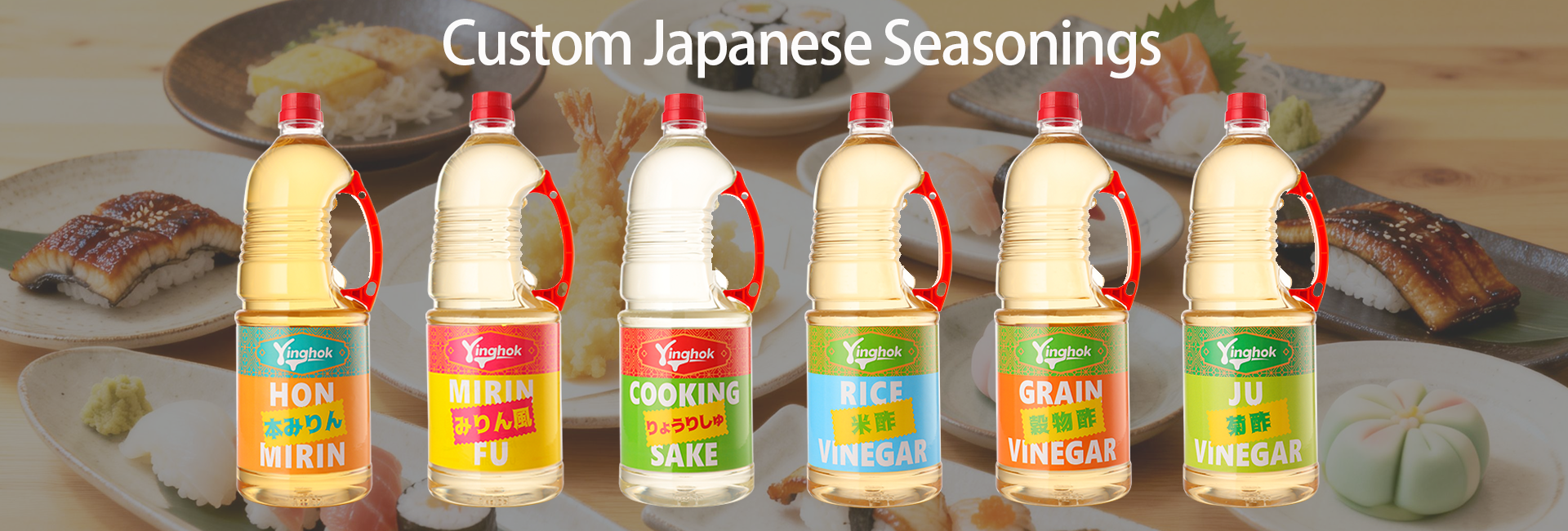
Why Japanese Seasonings Matter in Commercial Food Production
Flavor impact and process impact are linked
Core Japanese Seasoning Categories for Manufacturers
Seasoning category
Typical functional contribution
Commercial applications to evaluate
Key specification questions
Rice vinegar
Clean acidity and balance
Sushi rice, pickles, dressings, marinades, ready meals
Acidity, sweetness, color, aroma, ingredient declaration
Sushi vinegar
Ready-to-use sweetened acid profile
Sushi restaurants, central kitchens, prepared sushi, meal kits
Application concentration, rice type, sweetness, salt, pack size
Hon Mirin
Sweetness, aroma and potential gloss in cooked applications
Teriyaki, glazing, simmered foods, ramen-related sauces
Alcohol level, sweetness, viscosity, heating process, legal category
Mirin Fu
Mirin-style flavor with little or no alcohol, depending on formula
Foodservice, central kitchens, industrial sauce systems
Alcohol status, sweetness, cost target, label language, market restrictions
Cooking sake
Aroma and savory support in cooked foods
Seafood, meat processing, ramen soup bases, sauce manufacturing
Alcohol level, aroma intensity, salt contribution, process temperature
Grain vinegar
Fermented acidity and seasoning support
Pickling, sauces, dressings, food processing
Acidity, raw-material description, sensory profile, stability data
What Yinghok Supplies as a Japanese Seasoning Manufacturer
Custom Rice Vinegar
Custom Sushi Vinegar
Custom Hon Mirin
Mirin Fu
Custom Cooking Sake
Custom Grain Vinegar
How Seasonings Affect Flavor, Texture and Processing
Acidity and flavor balance
Sweetness, gloss and browning
Aroma and odor management
Viscosity, pumping and filling
Manufacturer Selection: What B2B Buyers Should Verify
Formula development and specification control
MOQ, lead time and supply planning
Packaging and label coordination
Quality Control, Certifications and Food Safety Documentation
Sample Development to Bulk Supply: A Practical OEM Workflow
Procurement Scenarios: Foodservice, Retail, Halal and Export
Questions to Ask Before Approving a Supplier
FAQ: Japanese Seasonings for Food Manufacturing
What Japanese seasonings are commonly used by food manufacturers?
Can Japanese seasonings be customized for a private-label product?
What is the difference between Hon Mirin and Mirin Fu?
What MOQ should a buyer expect?
How should shelf life and storage be confirmed?
Does a food-safety certificate guarantee that a finished product is compliant in every country?
Can Yinghok support samples and bulk supply?
Planning a New Japanese Seasoning Line?

Build Your Japanese Seasoning Range with a Factory-Direct Manufacturer