Custom Salad & Kimchi Sauce Manufacturer: How to Specify Fermentation Stability Before You Order
- Share
- publisher
- Yinghok
- Issue Time
- Oct 30,2026
Summary
A formulation and specification guide for buyers working with a custom salad and kimchi sauce manufacturer: why kimchi sauce fails at the operator's bench rather than in the recipe, the three parameters to pin in writing (acidity, salt, viscosity at two temperatures), how retail private label and foodservice kimchi sauce differ, where emulsion dressings fit on the same line, a five-step bench test before a bulk order, and a seven-line purchase specification that survives an audit.
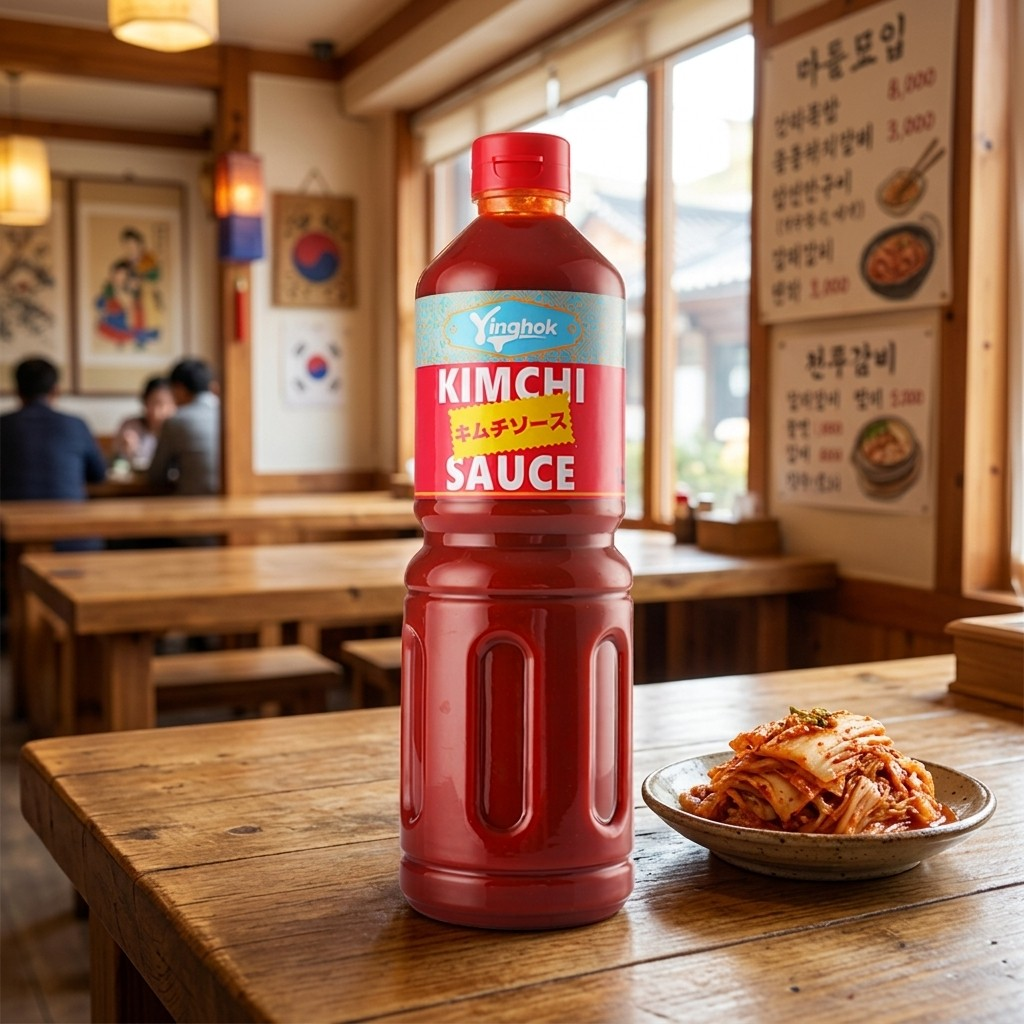
Quick Answer
As a custom salad and kimchi sauce manufacturer, the specification that decides success is not flavour — it is fermentation behaviour at the operator's temperature. A kimchi sauce built for a 5 °C cold chain will behave differently in a 20 °C kitchen within 48 hours.
- Pin three numbers in writing: target acidity, salt level and viscosity at your service temperature.
- Split retail-private-label and foodservice SKUs — they need different pack formats and different fermentation headroom.
- Test the sauce in the operator's actual tub, at the operator's actual temperature, before the first bulk order.
Why Kimchi Sauce Fails in Commercial Use — and It Is Rarely the Recipe
Most complaints we receive about kimchi sauce are not complaints about taste. They are complaints about what the same sauce did on day three.
A sauce that tested perfectly at the factory can arrive at a restaurant
kitchen, sit in a tub on a prep bench at 18–22 °C during service, and continue fermenting. Acidity climbs, the sauce thins as the vegetable releases water, and the colour dulls. The operator blames the supplier, and the supplier blames the storage — and both are partly right, because nobody specified the operating window in the first place.
This is the gap a specification closes. Below is the sequence we use when a buyer asks us to develop a kimchi or salad sauce for their own label, applied to the actual SKUs in our custom salad and kimchi sauce range.
What Should a Kimchi Sauce Specification Pin Down First?
Three parameters, agreed in writing before any sample is made. They are the three that behave differently at the customer's bench than they do at the factory.
Target acidity
A kimchi sauce continues to acidify after packing. The specification should state an acidity window at packing and the maximum accepted at end of shelf life, not a single figure.
Salt level
Salt controls both the rate of fermentation and the water the sauce draws out of cabbage. A salt level chosen for retail palatability often underperforms in a kitchen that holds the tub open for eight hours.
Viscosity at service temperature
Measure at 5 °C and again at 22 °C. A sauce that pours cleanly from a chilled pouch can turn slack on a warm bench; a sauce thickened for bench use can clog a pump in a chilled line.
Exact target values are development-specific and are agreed with each buyer during sampling — reference figures in this article describe the method, not a universal recipe.
The fourth parameter buyers forget: pack format
Pack format is a formulation decision, not a logistics one. A 180 ml to 1 L private label kimchi sauce designed for retail resale and a 1.8 L to 18 L foodservice kimchi sauce designed for a kimchi factory are not the same product in two bottles. Headspace, fill temperature and the rate at which the pack is opened and reclosed all change the fermentation trajectory, and our packaging guide on glass versus flexible pouches covers that decision separately.
How Do Retail and Foodservice Kimchi Sauce Differ?
They differ in three structural ways, and treating them as one SKU is the most common specification mistake we see from first-time private label buyers.
| Dimension | Retail / private label | Foodservice / kimchi factory | What breaks if you ignore it |
|---|---|---|---|
| Pack range | 180 ml, 200 ml, 230 ml, 260 ml, 300 ml, 450 ml, 1 L | 1.8 L, 1.9 L, 2 kg, 3.78 L, 18 L | Retail bottle used at volume becomes cost-heavy; 18 L drum on a shelf is unsellable |
| Opening cycle | Opened and resealed repeatedly at home | Opened, portioned, resealed once per shift | Retail oxygen exposure accelerates browning faster than the label implies |
| Fermentation headroom | Narrow — must stay stable for the consumer | Wider — the operator expects continued development | Retail-grade sauce used in a warm kitchen turns sour mid-service |
| Label claim surface | Front-of-pack claims drive the sale | Spec sheet and consistency drive the reorder | Retail claims do not help a chef who needs repeatable behaviour |
| Reference shelf life | 18 months (both kimchi SKUs) | 18 months (both kimchi SKUs) | Shelf life is identical — the difference is how it is consumed |
Pack ranges and the 18-month reference shelf life above are taken from our current kimchi sauce listings. Confirm the exact size set and shelf-life statement at quotation.
Where Do Salad Dressings Fit in the Same Production Line?
A kimchi sauce and a salad dressing are produced with the same equipment but are not interchangeable on specification. The difference matters to a buyer assembling a portfolio rather than a single SKU.
A Japanese vinaigrette is an emulsion: its risk is separation, and the specification question is how long it holds at 5 °C before the oil phase shows. A halal wasabi salad dressing adds a certification dimension on top of the emulsion question, which restricts which ingredient sources can be used at all. A Hawaiian-style poke sauce and a ponzu are both soy-base systems where the risk is colour drift and acidity balance rather than separation.
That is why the practical question for a chain buyer is portfolio coverage, not unit price: one supplier who can hold a kimchi sauce, an emulsion dressing and a soy-base dip on a controlled specification is cheaper to manage than three suppliers who each excel at one and cannot document the others.
| SKU family | System type | Primary stability risk | Reference shelf life | Reference pack range |
|---|---|---|---|---|
| Korean style kimchi sauce | Fermented, chilli-base | Continued acidification in the tub | 18 months | 180 ml – 1 L |
| Foodservice kimchi sauce | Fermented, chilli-base | Acidification plus water release at bench temperature | 18 months | 1.8 L – 18 L |
| Japanese vinaigrette | Emulsion | Phase separation on chilling | 18 months | 180 ml – 3.78 L |
| Halal wasabi dressing | Emulsion with certification constraints | Separation plus sourcing restrictions | 12 months | 180 ml – 3.78 L |
| Poke sauce | Soy-acid base | Colour drift and salt pickup | 12 months | 180 ml – 18 L |
| Ponzu | Citrus-soy base | Citrus oil oxidation over time | 18 months | 180 ml – 18 L |
| Tempura dipping sauce | Dashi-soy base | Umami fade and dilution at the fry station | 12 months | 1.8 L – 10 L |
How Do You Test a Kimchi Sauce Before Committing to a Bulk Order?
Do not accept a factory taste test as evidence. The sauce has to be tried in the conditions it will live in.
- Request the sample in the real packAsk for the 1 L retail bottle and the 1.8 L foodservice pack separately, not a laboratory jar. Fill format affects headspace and therefore the fermentation path.
- Run a 72-hour bench trialHold an opened pack at your own kitchen temperature for three service days. Record acidity, viscosity and appearance each morning rather than only at the end.
- Run a parallel 7-day chilled controlHold an unopened pack at 5 °C. If the bench pack and the chilled pack differ materially by day seven, the specification needs a narrower operating window.
- Cook with it, not just taste itA kimchi sauce is used on cabbage, on rice bowls and as a dressing. Water release shows up within two hours on shredded cabbage, which a spoon test will never reveal.
- Confirm the label and certification scopeIf the pack carries a claim relevant to your market, ask for the certificate reference and the scope statement rather than a logo. Our wholesale Asian sauce buying checklist sets out what to request.
Only after those five steps should a first bulk order be released, and the first release should be a single pallet rather than a container.
What Does "Custom" Mean for a Kimchi Sauce Manufacturer in Practice?
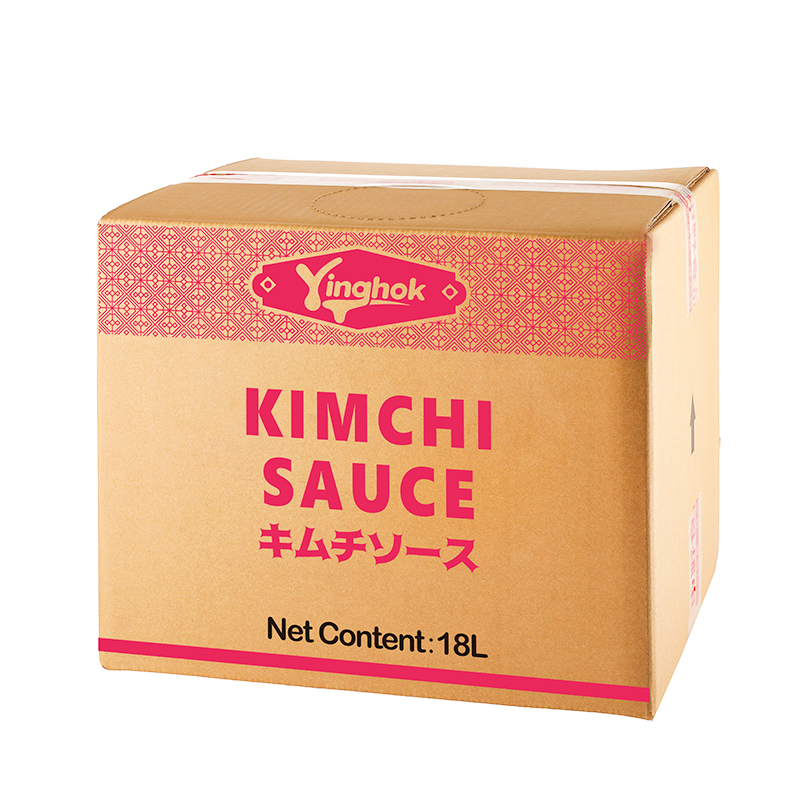
The 1.8 L to 18 L formats are where foodservice customisation actually happens.
Customisation in this category is usually described as flavour adjustment, which understates it. Four things change together when a buyer commissions a bespoke kimchi sauce.
Formula. Chilli heat level, salt level, sweetness, the ratio of fermented to fresh components, and whether the sauce is designed to be used straight or cut with rice syrup at the operator's end. Each of those is a development decision made against samples.
Pack and fill. Size set, closure type, label placement and fill temperature. A sauce designed for hot fill cannot simply be switched to ambient fill without rechecking the stability assumption.
Documentation. Certificate scope, ingredient origin statements, and the specification sheet that your own quality team will audit against. The difference between OEM and private label sits largely here rather than in the sauce itself.
Volume and release schedule. A private label launch and a foodservice contract have different first-order profiles. A retailer needs a full size set at launch; a kimchi factory needs one large format repeated.
We at Yinghok, a custom salad and kimchi sauce manufacturer, run these four decisions as one development conversation rather than four separate quotes, because a formula agreed without the pack format is only half specified.
What Goes Wrong at the Operator's Bench?
A tub held open through an eight-hour service is the harshest test a kimchi sauce faces.
Four failure patterns account for most of the complaints in this category, and each traces back to a specification gap rather than a production defect.
- Souring mid-service. The sauce keeps fermenting in a warm tub. The fix is a narrower accepted acidity window agreed with the buyer, plus a stated bench-life expectation on the spec sheet.
- Water pooling. Salt draws water out of the cabbage faster than the sauce can hold it. The fix is a viscosity and salt target tested on the buyer's actual vegetable, not on a laboratory sample.
- Colour dulling. Oxidation after repeated opening. The fix is pack size matched to the operator's daily usage — a 3.78 L pack used over two weeks will dull where an 1.8 L pack will not.
- Inconsistent heat from batch to batch. Chilli raw material varies by harvest. The fix is a stated sensory target and a retained sample per batch, which is a supplier documentation discipline rather than a recipe change.
Our notes on storing and preserving leftover kimchi sauce cover the operator-side half of this problem; the supplier-side half is the specification sheet.
How Do You Write the Purchase Specification?
A kimchi sauce purchase specification that survives an audit has seven lines. Anything shorter moves the risk onto your quality team after the goods arrive.
| Line | What to state | Why the auditor asks for it |
|---|---|---|
| Product identity | SKU name, model reference, intended use (retail resale or foodservice) | Prevents a retail-grade pack being substituted for a foodservice one |
| Formula targets | Acidity window, salt level, viscosity at two temperatures | Gives a measurable acceptance criterion instead of a taste opinion |
| Pack and fill | Size, closure, fill temperature, headspace | Explains any deviation found during incoming inspection |
| Shelf life basis | 18 months reference, stated storage conditions | Ties the label date to a documented condition |
| Certification scope | Certificate reference and the product types it covers | Confirms the claim applies to this SKU, not just to the company |
| Batch documentation | Retained sample, batch code, production date | Enables traceability if a complaint arrives three months later |
| Change control | Who approves a formula or supplier change, and how it is notified | Stops silent reformulation between orders |
The seventh line is the one buyers most often leave out, and it is the one that protects a multi-year contract. A supplier who will put change control in writing is easier to keep than one who will only agree to it verbally.
Our wider Asian cooking sauce range runs on the same specification logic, so a buyer building a multi-SKU portfolio does not have to maintain seven different document standards for seven sauces.
Frequently Asked Questions
What shelf life does your kimchi sauce carry?
18 months for both the retail and foodservice kimchi sauce listings, stored in a cool, dry place. Confirm the stated condition at quotation, because shelf life is tied to the storage assumption.
What pack sizes are available for kimchi sauce?
Retail and private label: 180 ml, 200 ml, 230 ml, 260 ml, 300 ml, 450 ml and 1 L. Foodservice and kimchi factory use: 1.8 L, 1.9 L, 2 kg, 3.78 L and 18 L.
Can the heat level be adjusted for my market?
Yes — chilli heat, salt and sweetness are development variables agreed against samples. The specification should record the agreed target rather than a single tasting note.
Do you supply halal salad dressings as well as kimchi sauce?
Yes. The halal wasabi salad dressing is produced as a separate SKU with its own certification scope, which constrains ingredient sourcing compared with a non-halal emulsion dressing.
How should we test before a first bulk order?
Request the real pack format, run a 72-hour bench trial at kitchen temperature alongside a 7-day chilled control, and cook with the sauce rather than only tasting it. Release a single pallet before a container.
Start With the Bench, Not the Bottle
If you are developing a kimchi sauce, a salad dressing or a multi-SKU Asian sauce portfolio, send us three things: the operating temperature your product will live at, the pack size your customer will actually open, and the market claims your label needs to carry. Those three answers define the formulation conversation far better than a flavour request.
OEM
Private label
Foodservice bulk
Our team reviews incoming specifications as the first stage of development and returns a sample plan with the pack formats that suit the intended channel.